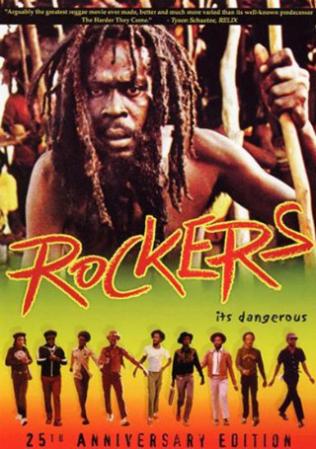
"Rockers" (1978)
Drama/Action
Directed by Theodoros Bafaloukos
1. How does the main character, Leroy "Horsemouth" Wallace, compare to the other main characters (Ivan Martin and Derrick Thompson) in the first two films we saw?
All the characters are completely different to each other in the different movies, and that is not because their age, social stratum, culture or etc. It's because the premise of this movie last movie is different from Ghett'a life or The harder they come. In this movies the main characters were people with very specific conditions and individual goals that made them special and stand out from the other characters from the movies. Their goals were personal and they had to go thru a lot of obstacles enduring violence to achieve them.
Rockers represent the ideology of Rastafari, the importance of the community and the fall of those in power. So the construction of this character, Leroy "Horsemouth", it's done from his communication, behavior and actions in the community and their shared goal. Leroy could be anyone in real life, he hasn't a special condition, like be son of some important politician or be a sociopath serial killer, he is just a man of the community with leading capabilities with a shared goal.
I really liked this movie because of the formal operations in it, make this movie unique and super fun to watch. The script is simple but the premise it's powerful, and all the elements in the movie construct a super plausible fictitious world that is nice to watch. It doesn't pursuit a Hollywood style, instead looks almost like a documentary and it's super sensitive about the details of the location and the interaction of characters in it. Making this movie a sensitive experience meanwhile the plot goes by.
The first element that separate this movie from any other fiction is in the beginning, when the rasta man speaks directly to the camera about the tenets of the Rastafari movement and how the see violence, power and love. This happen a second time in middle of the movie after Leroy suffers violence and he speaks again to the spectators about these principles and why rastas prefer peace and avoid violence.
This particular scenes coupled with the photography work in the movie, makes it look super realistic. The camera most of the time take some distance from the characters, and take long shots without cuts, allowing the spectators to appreciate the relation of space and time of the characters and the places were they unfold and take action.
Uses mostly wide and close shots with little movement, making images full of textures, colors and depth of field that accompanied with a fine direction of art with a careful choice of props and colors, creates some rich and powerful images full of meaning.
Sometimes uses steady cams with long shots to follow Leroy in complex spaces full of people and interactions of all types, that allows spectators to feel like they are actually in the movie living the experiences with the characters.
The movie uses a lot of reggae music and direct sound, sometimes the dialogues get lost in all the ambient noise, and that's okay, because since the beginning the movie propose this code of realism that's super easy to catch.
All i wanna say here is that the movie is so well constructed and all is made to exalt the premise of Rastafari principles, and the context of poorness and community where this happens. Works really well.
3. In conclusion to our Jamaican film unit, which was your favorite film of all 3? Why?
Rockers is exactly my taste of movie and i really liked it, and not just for that, also because i think is the most honest movie of all three showing us the identity of Jamaican and Rastafari culture.
I don't like those movies where one character is a hero and does everything. In the reality changes occur in community like a group action, and that requires culture, ideology, organization and planning.
This movie show us all really well the reality that Jamaicans lived and how important Rastafari tenets were in the social relations and organization. So Rockers was my favorite in all of this aspects, including the technical ones that made this movie a whole different experience than the other one that we have seen before.

Regarding the third point, I didn't consider that the movie is actually very authentic and the protrayal of the Rastafari being very present. I agree with your cinematographic perspective, the camera work is really good.
ResponderEliminar